
I’ve spent 20 years in SEO. I got started back when a single well-placed keyword could carry a page, and I’ve watched nearly every “this changes everything” moment the industry has seen since.
Most of them didn’t change everything. This one might.
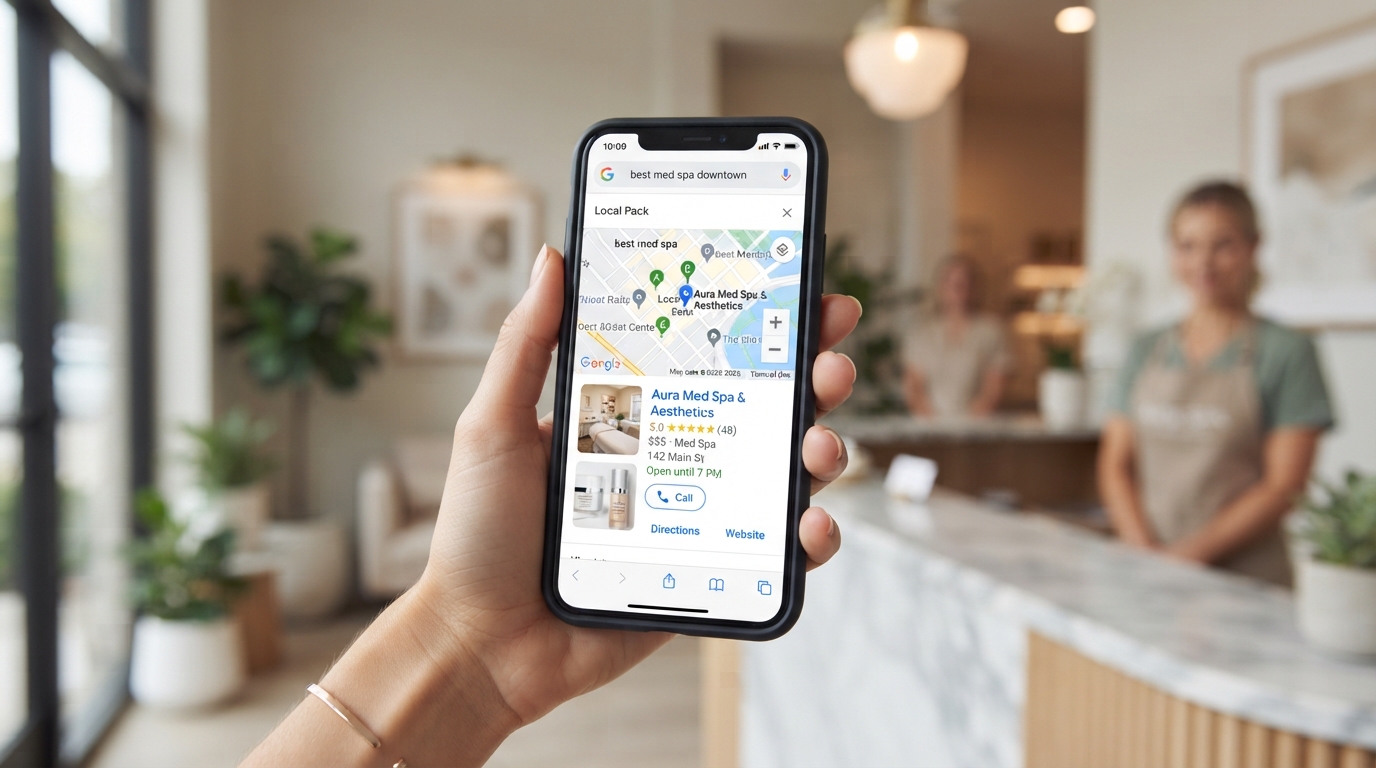
Patients used to Google “best med spa near me” and click through a list of blue links.
Now, more of them are asking ChatGPT, Gemini, or Perplexity instead, and getting a direct answer with two or three practices named in it.
If your practice isn’t one of the names mentioned, you don’t just rank lower. You don’t exist in that conversation at all.
This is called Answer Engine Optimization, or AEO. Here’s the quick version, then the detail behind it.
The Short Version
- Keep your business data consistent everywhere. Name, address, phone, hours, and services need to match across your website, Google Business Profile, and every directory you’re listed on.
- Answer the whole question, not just the headline. Cover candidacy, what the treatment involves, recovery, and what to expect, not just a vague service description.
- Build genuine authority off your site. Reviews, local press, YouTube, Reddit, and anywhere else credible sources recognize your expertise. All of it needs to be real, not manufactured.
- Get specific about what you’re known for. Clear positioning beats “we do a little of everything.”
- Show your credentials, not just your services. Certifications, training, awards, and real case studies build the trust AI models are looking for.
- Keep your content current. Stale pages signal outdated information, refresh service pages and FAQs regularly.
Here’s why each of these matters.
This Isn’t a New Game, It’s the Same Game With New Rules
There’s a lot of noise right now claiming AEO is a completely different discipline from SEO, one that requires starting over.
That’s not accurate, and it’s often coming from people trying to sell you something “totally unique.”
Everything that already works in good SEO still works. What’s different is how the win gets counted.
In Google search, ranking first wins the click.
In an AI answer, the AI is summarizing many sources at once, so what matters is how many times your practice gets mentioned across everything the model can see, not whether one page outranks another.
Get the Basic Facts Straight
Before content or citations can do any work, there’s a foundational piece that trips up more practices than anything else: consistency.
AI models build their understanding of a practice from its business data everywhere that data appears online, your website, Google Business Profile, Yelp, Healthgrades, RealSelf, and every other directory you’re listed on. The details that need to match everywhere:
- Name
- Address
- Phone number
- Hours
- Services offered
- Specific attributes patients search for, like “same-day appointments available”
If your website says you close at 6pm and your Google Business Profile says 7pm, that’s a red flag to an AI model. It can’t confidently recommend a practice it isn’t sure is even open.
You Can Win This Fast
A brand-new practice with a brand-new website has almost no chance of ranking competitively in traditional SEO right out of the gate. Google rewards domain authority, and that takes months or years to build.
AEO doesn’t work that way. You can be mentioned in a citation, a Reddit thread, a YouTube video, or a blog post tomorrow, and start showing up in AI answers almost immediately.
A practice that just opened its doors can compete with one that’s been established for a decade, as long as it’s getting mentioned in the right places.
The Leads Are Different, and They’re Better
Companies studying this have found conversion rates from AI-referred traffic running several times higher than traditional search traffic.
Our read on why: someone who’s had a back-and-forth conversation with an AI has already narrowed down what they want before they ever land on your site. They’re pre-qualified by the conversation itself.
For a med spa, the person clicking through from an AI answer about “best Botox provider near me” isn’t comparison shopping five tabs deep.
They asked follow-up questions, got specific, and arrived already leaning toward booking.
What Actually Gets a Practice Cited
On your site, pages need to answer the follow-up questions, not just the obvious one. If someone asks “what’s the best med spa for Botox in [city],” the model is looking for a source that also covers:
- Your expertise
- What to expect at a first visit
- How long results last
- Who’s a good candidate
Vague copy like “we provide comprehensive aesthetic care” gives an AI nothing concrete to cite.
Help center and FAQ content matters here too, the specific, practical questions patients actually ask are exactly what AI tools are surfacing answers for.
Stale pages are a quiet liability: revisiting service pages and FAQs regularly signals to AI models that the information is current, not something posted once and forgotten.
Off your site, AI tools build their answers from citations across the web:
- Review platforms
- Local directories
- YouTube
- Industry blogs
Reviews matter more than most practices realize, and not just as a star rating. AI models read reviews as source material.
“Great service” gives an AI nothing to work with.
“I came in for a Botox consultation, the injector explained exactly what to expect, and the results looked completely natural” gives the AI language it can actually cite.
Recency matters too, a practice with hundreds of reviews where the newest one is six months old reads as stale.
What doesn’t work: fake reviews, spam comments, mass-produced content with no real person behind it. These platforms, and the AI models pulling from them, are good at spotting that.
What works: legitimate patient reviews, genuine local press mentions, and a practice actually recognized as excellent in its market.
Be Clear About What You Actually Are
An AI model is matching a specific question to the most confident answer it can find.
A practice that positions itself as doing a little of everything gives the model nothing specific to grab onto.
A practice known for one or two things, advanced injectables, a specific device, a specific patient demographic, is a much easier match.
This isn’t about narrowing your actual services. It’s about how clearly your website, reviews, and citations describe what you’re known for.
“We provide comprehensive aesthetic care” tells an AI model nothing.
“Specializing in natural-looking Botox and filler results for first-time patients” tells it exactly which question you’re the answer to.
Show Your Credentials, Not Just Your Services
AI models are gauging trust, not just relevance.
A page that lists services without any indication of who’s behind them gives the model less reason to treat that source as authoritative than a page that clearly establishes:
- Board certifications
- Years in practice
- Specific training on a device or technique
- Awards
- Before-and-after case studies
A named, documented case study with specifics on what was done and what the outcome was gives an AI model concrete language to cite.
A vague “amazing results” gallery with no context does not.
Build Your Authority Beyond Your Own Site
Everything above helps an AI model understand and trust your practice. But authority isn’t built on your website alone, it’s built by how consistently credible sources across the web recognize you.
That means genuine mentions in local press, being referenced by other trusted sites in your area, having your credentials show up consistently wherever your practice is discussed, not just once on an About page.
The more places a practice’s expertise gets independently confirmed, the more confidently an AI model will treat it as a trustworthy source to cite, rather than just one of several similar options.
This builds over time, and it compounds with everything else in this post: clear positioning, visible credentials, and real reviews all feed into the same authority an AI model is trying to gauge before it decides who to name.
Our Commitment to Staying Ahead of This
I’ve been doing this for two decades because it’s genuinely interesting, not because we found one strategy that worked and stopped paying attention.
The practices we work with get an SEO strategy that keeps evolving with the actual landscape.
AI search isn’t replacing traditional search. It’s adding a new channel on top of it, one with real opportunity for practices willing to show up authentically and answer the questions patients are actually asking.
That’s exactly where our focus is right now, and where it’ll stay as this keeps evolving.